
Informational obesity: why you end the day exhausted from reading nothing
Manthana Foundation | Keerthi Aithal | 5 min read
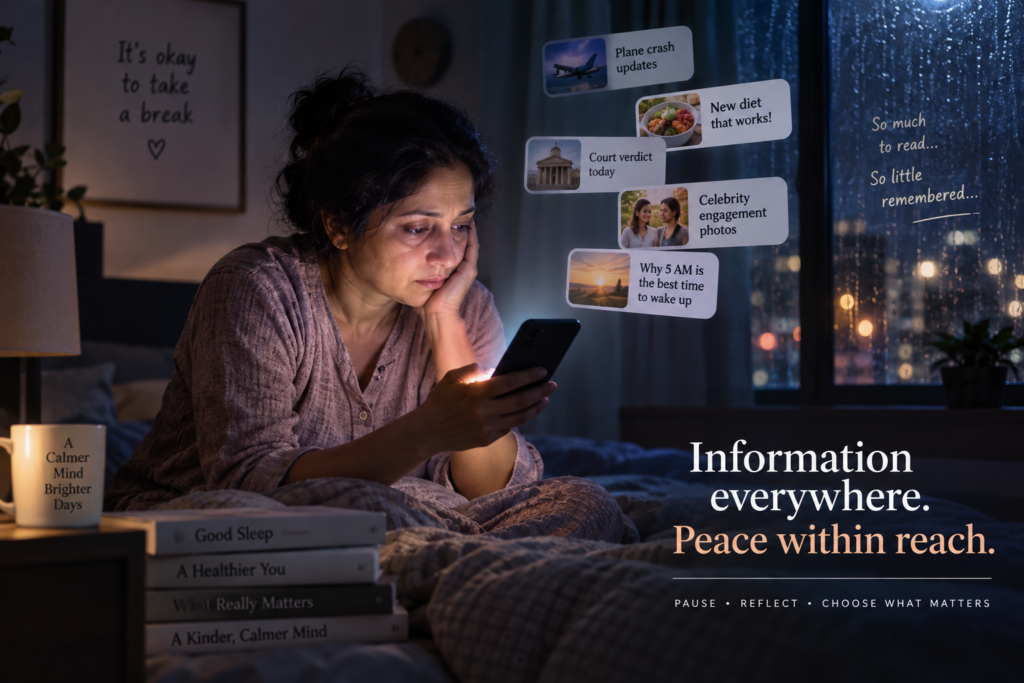
You opened the phone to check one message. That was at 9:40. It is now past eleven, and since then you have read about a plane crash, a diet, a court verdict, someone’s engagement photos, and a video explaining why five in the morning is the only correct time to wake up. You could not repeat a single line of any of it. Your eyes are dry. Your shoulders have crept up towards your ears. And the message you actually picked up the phone for is still sitting there, unanswered.
Nothing happened to you tonight. So why does your head feel like something did?
What is actually filling up: There is a name for this state. Informational obesity. The term borrows a word from the body, but it has nothing to do with anyone’s body or anyone’s weight. It describes a mind that is fed continuously and never given the quiet to digest. Information keeps arriving. Almost none of it gets sorted, used, or turned into a decision. It simply piles up.
You are not short of information. You are soaked in it. And here is the part that catches people off guard: more information does not make you feel more prepared. Past a certain point it makes you slower, more doubtful, and more anxious than you were before you started reading.
Signs you are carrying this:
- You reach for the phone in every gap. The lift, the autorickshaw, the two minutes before sleep.
- You finish an hour of scrolling and cannot name three things you saw.
- You keep twenty tabs open because closing them feels like losing something.
- You feel permanently slightly behind. Behind on news, on work updates, on whatever everyone else already seems to know.
- You read about a symptom and now you are fairly sure you have it.
- Your saved-articles folder has become a graveyard. You save instead of reading.
- Small decisions have started to feel tiring. Which phone, which school, which doctor.
- The first thing you touch in the morning is the screen. Before water, before anyone’s face.
One or two of these is just modern life. Five of them, most days, is a pattern worth taking seriously.
Why you cannot simply put it down: Your brain was not built only to seek food and safety. It seeks information, and it treats new information as a small reward. That is why the pull feels physical rather than reasonable.
Now add the design on top of that. The feed has no bottom. There is no last page, no closing line, nothing that tells you that you are finished. What comes next is unpredictable, and unpredictable rewards are the hardest kind to walk away from. It is the same principle that keeps a person standing at a slot machine.
So no, this is not laziness, and it is not weak character. When your uncle says “phone bidu, swalpa control maadu” (put the phone down, show some self-control), he is describing the problem as though the solution were obvious. It is not obvious. You are up against something built by people whose full-time work is keeping you there.
You feel informed. Mostly, you are not: There is a real difference between passing information across your eyes and actually holding it. Twenty headlines on a subject can leave you with a firm opinion and no facts. That is an uncomfortable sentence to read, and it matters, because you will make genuine decisions on the strength of that feeling. Which school. Which treatment. Whether to worry about a lump.
Ask yourself honestly: when did you last read something and then say it out loud to another person, in your own words? That step is what converts input into knowledge. Almost nothing you consumed this week ever reached it.
The world gets worse without anything changing: Your sense of how dangerous life is does not come from statistics. It comes from how easily examples arrive in your mind. Spend an hour reading about accidents, assaults and rare diseases, and those examples become very easy to reach indeed.
So the roads feel more dangerous than they were yesterday. Neighbours feel less trustworthy. You tell your daughter to take an auto instead of the bus, and you could not say precisely what changed, because nothing changed. Only your sample did.
Notice what this does inside a family. Fear travels quickly between people who love each other. One person’s midnight reading becomes everybody’s new rule by breakfast. If you are the one making rules for somebody else, it is worth asking where the rule actually came from.
When the searching is actually anxiety: Sometimes this is not a habit at all. It is a symptom wearing the costume of a habit.
Listen for these sentences in your own head:
- “I just want to be prepared.”
- “One more article and I will know for certain.”
- “Let me see what people are saying, then I will sleep.”
Searching settles the worry for about a minute. Then it returns slightly stronger, so you search again. Health searching does this most reliably of all. There is even a name for the loop. ‘Cyberchondria’ is the pattern where looking up symptoms online steadily raises health anxiety instead of settling it. Add a family WhatsApp group forwarding “ten early warning signs” at midnight, and the loop runs without your help.
If that is what is happening, no amount of screen-time discipline will fix it. The phone is not the problem. The anxiety underneath it is.
Decide before you open, not after: Say the purpose out loud before you unlock the screen. “Reply to Amma.” “Check the bus timing.” Then do that one thing and stop! The plan has to exist before the feed does, because the moment the feed starts, you are no longer the one choosing.
Keep the bed out of it: Charge the phone in another room, or at the far end of this one. Not on the pillow. This single change does more for sleep than anything else on this list, and broken sleep is the fastest route to a worse mood, weaker concentration, and more scrolling the following night. In a house where your bedroom is the only private space you have, this is genuinely hard. Do the version you can actually keep. Across the room still counts!
Answer the question once, then close it: For health searches especially, decide the rule in advance. One reliable source, one search, then the tab shuts. If you find you cannot stop at one, that tells you something useful about your anxiety, not about the illness. Write the question down and carry it to a doctor instead. Five minutes with someone who can actually examine you will settle what forty tabs never will.
Give something back before you take more in: Once a day, produce instead of consume. Tell one thing you read to someone at home. Write four lines about it. Explain it to a colleague at lunch. The mind sorts information properly only when it is forced to hand it over. That is the digestion step that has gone missing, and it costs you ten minutes!
You will not repair this by deleting everything for a week and then returning exactly as you were. Aim lower and keep it. One input fewer. One protected hour. One night the phone sleeps in the hall.
And sometimes the scrolling is sitting on top of something heavier. Anxiety that was already there. A mood that has been low for months. Sleep that broke long before the feed ever got interesting. Treat that as the real problem. Counselling for this can happen from your own house, in Kannada or English, without anyone in the building knowing you did it. Where the anxiety or the sleeplessness has run long enough to need a medical opinion, a psychiatrist’s assessment belongs alongside the counselling rather than instead of it. Neither one begins with a test you can fail. It begins with a conversation.